Cloud Base
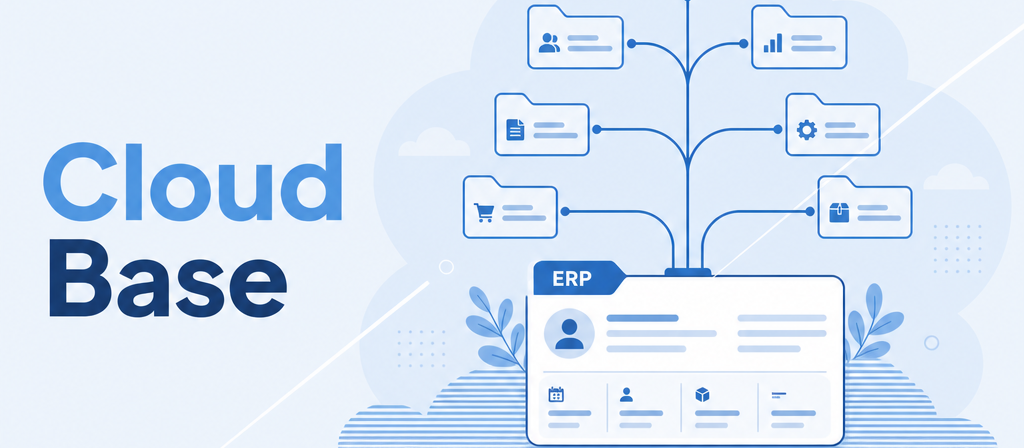
One folder tree for every document type — defined once, applied to every record.
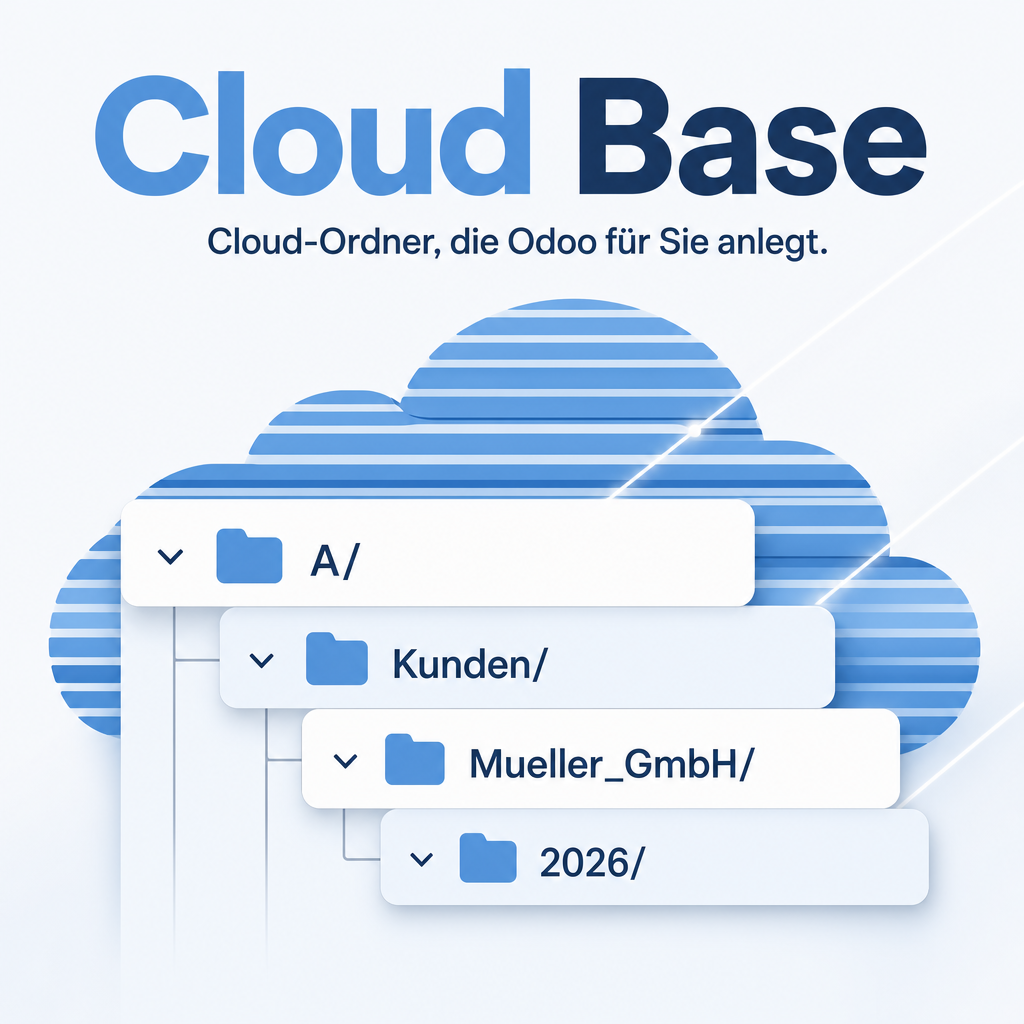
Cloud Base is the shared foundation of the Equitania cloud connectors. You configure the folder structure once per document type — contacts, sales orders, purchase orders, invoices, products, transfers, employees, leads — and every record gets its cloud path from that configuration: ERP/Customers/A/Azure_Interior/Documents/2026/, built from the record's own fields. A smart button opens the folder, a Check Path action compares the expected structure with the cloud, and a dedicated security group keeps export, import and configuration with the administrators. The NextCloud Connector or the OneDrive Connector adds the actual cloud account.
Features
Folder configuration per document type
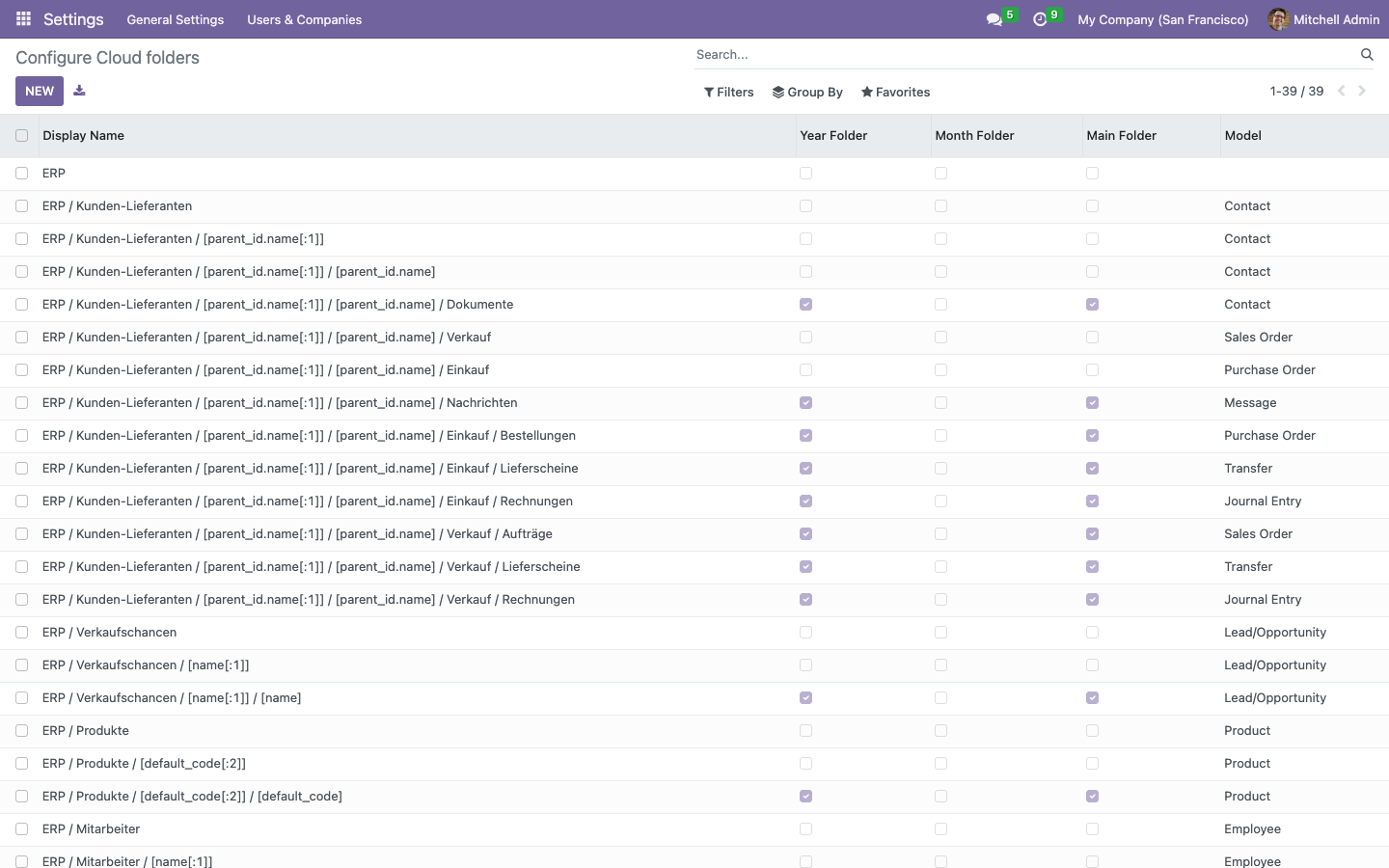
The folder tree is a list of configuration lines under Settings → Cloud → Cloud Folders. Every line names a folder, the model it belongs to and whether it is the main folder of that model.
- Field expressions inside brackets:
[name],[parent_id.name],[name[:1]]for an A–Z index folder,[default_code[:2]]for a product group. - Year and month folders at any level, with placeholders such as
%(year)sand%(month)s. - Template files attached to a folder line are uploaded when the folder is created for the first time.
Cloud-safe names without manual work
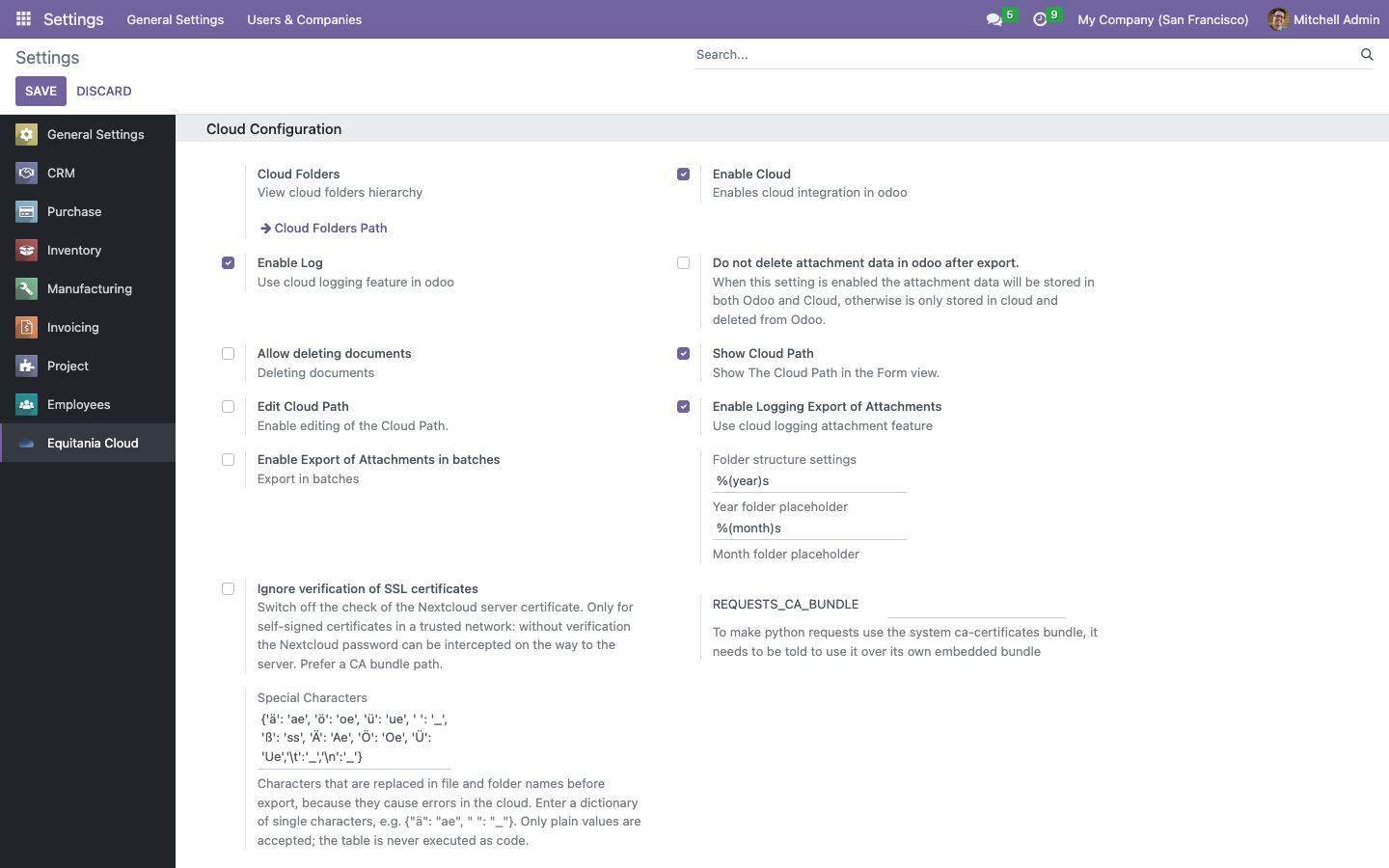
Umlauts, spaces and characters the cloud rejects are replaced before a folder or file name reaches the cloud. The replacement table is a setting: {"ä": "ae", " ": "_"} is the default, and you can extend it. The table is validated and never executed as code.
- Same rule for folder names and file names, so Müller & Söhne becomes
Mueller_&_Soehneeverywhere. - Slashes, colons, question marks and similar characters become underscores.
Smart button and path check on every record
Each configured model shows the cloud path and a Documents smart button that opens the record's folder in the cloud. The Check Path action compares the configured structure with what exists in the cloud and lists missing folders or template files; one click creates them.
- Show or hide the path field and allow or lock its editing per setting.
- Create Cloud Structure builds the whole tree for one record on demand.
Settings in one place
Settings → Cloud holds the connection, the switches and the placeholders: enable the cloud, log the export of attachments, export in batches of a chosen size, keep or drop the attachment data in Odoo after the export, and the year and month placeholders.
- Keep attachment data in Odoo when you need the preview offline; drop it to keep the database small while the files stay in the cloud.
- The export log appears under Settings → Technical → Logging with start, count and every warning.
Responsibility stays with the administrators
The group Cloud Connector / Manager (part of Administration by default) is required for everything that touches the whole cloud account: export and import runs, moving or deleting files, registering a connection, editing the folder configuration. Regular users only trigger the folder creation for records they may edit anyway.
- Folder configuration, template files and the connector log are read-only or hidden for other users.
- External scripts need a technical user in that group.
Frequently Asked Questions
Which Odoo editions are supported?
The module runs on Odoo Community and Odoo Enterprise, version 16.0 — self-hosted or on Odoo.sh. Odoo Online, the hosted SaaS edition, does not accept apps from the store, so no third-party module can run there.
What does Cloud Base do on its own?
It provides the folder configuration, the cloud path fields, the smart buttons and the settings. Files are only transferred once the NextCloud Connector or the OneDrive Connector is installed on top.
Can I use Nextcloud and OneDrive at the same time?
One cloud provider per database: install either the NextCloud Connector or the OneDrive Connector on top of Cloud Base. Both use the same folder configuration, so switching later means installing the other connector and running its export once.
Which dependencies does the module have?
Only standard Odoo modules: Contacts, CRM, Sales, Purchase, Invoicing, Inventory, Employees and Discuss. Odoo installs them automatically; no Python package is needed.
Which fields can I use in folder names?
Any stored field of the model, including paths through a Many2one such as [partner_id.name]. An index selects characters of the value ([name[:1]]), which is how the A–Z index folders are built. Unknown fields are reported when the folder is created.
What happens to existing folders when I change the configuration?
Nothing is moved automatically. New records follow the new configuration; for existing records the Check Path action shows what is missing and creates it on request.
Do you provide support?
Yes. Write to support@equitania.de or open a ticket in the support portal at support.equitania.de.
Will it work after an Odoo update within the same major version?
Yes, within Odoo 16.x. A new Odoo major version is delivered as a new module version.
More solutions from Equitania · Weitere Lösungen von Equitania


Support · Kontakt
We are happy to support you · Wir unterstützen Sie gerne.


Weiherstraße 13
75173 Pforzheim
Deutschland · Germany
Telefon: +49 7231 16 604 0
Telefax: +49 7231 16 604 200
Homepage: www.ownerp.com · odoo2fast.report
Support: support.equitania.de
E-Mail: support@equitania.de
EN · All information on this page is provided for product description purposes only and is not legally binding. It constitutes neither a guarantee of quality nor an assurance of any particular scope of functions, fitness for a particular purpose or specific results; only the contractual agreements and the scope of delivery of the version actually installed are authoritative. Screenshots show example configurations. Product and company names mentioned are trademarks or registered trademarks of their respective owners; naming them implies neither affiliation with nor endorsement by those owners. This description was written with AI assistance and was reviewed and approved before publication; the German version prevails.